
How to Build a Rechargeable Flashlight with a 18650 Battery
A rechargeable flashlight built with a single 18650 lithium-ion battery can be compact, powerful, and practical for everyday use. This battery format is widely used in portable electronics because it offers a good balance of capacity, current delivery, and size.
In this guide, we will look at the basic idea behind building a rechargeable flashlight, why an LED driver is necessary, and how a driver such as the AP3031 helps power LEDs safely and efficiently.
Why Use a 18650 Battery in a Flashlight?
The 18650 cell is one of the most popular rechargeable batteries for DIY electronics and portable lighting projects. It is commonly used in battery packs, flashlights, power banks, and other high-demand devices.
- Nominal voltage: 3.7V
- Fully charged voltage: 4.2V
- Discharged voltage: approximately 2.7V to 3.0V
- Main advantages: rechargeable, high energy density, lightweight, and widely available
Because the battery voltage changes during discharge, the LED cannot always be connected directly to the battery if stable brightness and safe operation are important. This is why a proper driver circuit is needed.
Why an LED Driver Is Important
LEDs are current-driven devices. If they are powered incorrectly, they may overheat, lose brightness stability, or fail early. A good LED driver helps regulate current and, when necessary, increase the voltage so the LED receives the power it needs.
For flashlight projects using a single 18650 cell, a boost LED driver is often the best solution when the LED or LED string requires a higher voltage than the battery can provide directly.
Basic LED Types Used in Flashlight Projects
Standard LEDs
Small 3mm and 5mm LEDs are suitable for indicators and low-power lighting, but they are not ideal for powerful flashlights.
High-Power LEDs
High-power LEDs such as 1W, 3W, and 5W models are much better for flashlight applications. They can produce strong light output, but they need proper current control and thermal management.
COB LEDs
COB LEDs combine multiple LED chips in one package and can provide bright, even illumination. They are often used in floodlights and work lights, though some flashlight designs use them as well.
Simple Ways to Power an LED
Using a Resistor
For small, low-power LEDs, a resistor can be enough to limit current. The basic formula is:
R = (Vsource - VLED) / ILED
This method is simple, but it is not the best choice for high-power flashlight LEDs.
Using a Constant-Current Driver
For high-power LEDs, a constant-current LED driver is the preferred method. It keeps the LED current stable and improves both safety and performance.
Using the AP3031 in a Rechargeable Flashlight
The AP3031 is a compact boost LED driver IC that can raise the battery voltage and regulate LED current at the same time. This makes it a useful choice for rechargeable flashlight designs based on a single 18650 battery.
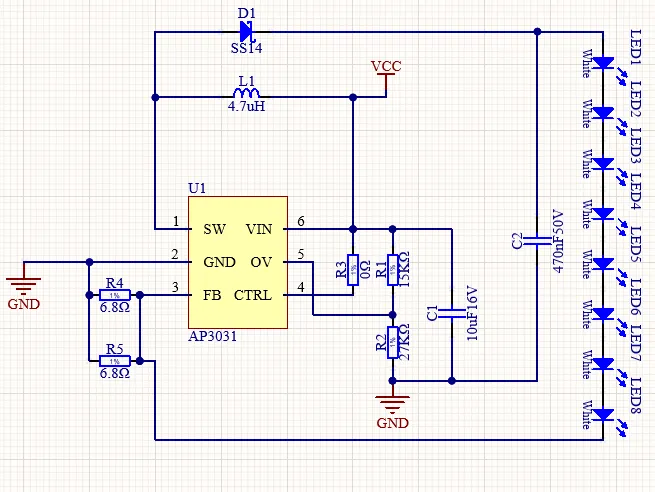
Main benefits of the AP3031 include:
- Works from low input voltages
- Can boost voltage for LED loads that need a higher supply
- Provides controlled LED current
- Offers good efficiency for portable devices
- Includes protection features such as thermal shutdown and overcurrent protection
Main Parts Needed for the Project
To build a simple rechargeable flashlight, you will usually need:
- A 3.7V 18650 lithium-ion battery
- An LED driver module based on the AP3031 or a similar IC
- A high-power LED
- A TP4056 charging module with protection
- An on/off switch
- A suitable enclosure or flashlight body
Charging the 18650 Battery Safely
A TP4056 charger board is a common and affordable solution for charging a single 18650 cell. Versions with built-in protection are strongly recommended because they help protect the battery against overcharge, overdischarge, and short circuit conditions.
Practical Design Notes
- Always use a quality 18650 cell
- Make sure the LED has proper heatsinking
- Use a protected charging module if possible
- Choose an LED driver that matches the LED current requirement
- Do not connect high-power LEDs directly to the battery without current control
Conclusion
Building a rechargeable flashlight with a 18650 battery is a practical electronics project and a good way to create a compact, reusable lighting solution. The key to reliable performance is using the right LED driver. A boost driver such as the AP3031 helps provide stable current, improve efficiency, and make better use of the battery.
If you are planning to build your own flashlight or LED lighting project, choosing the right battery, charging module, and driver circuit will make the design safer and more reliable.
Next Steps
If you want to understand the driver circuit in more detail (including the RISET current-setting formula and the OV protection behavior), read our technical guide: AP3031 Boost LED Driver Explained.
Prefer a ready-to-use solution for your build? See the product page here: 18650 LED Driver Module (AP3031).
Frequently Asked Questions
Why can’t I connect a high-power LED directly to a 18650 battery?
A high-power LED is current-driven. A direct connection to a lithium-ion battery can lead to uncontrolled current, overheating, unstable brightness, and LED damage. A constant-current LED driver is recommended.
What voltage range does a single 18650 battery provide?
A typical 18650 lithium-ion cell is about 4.2V when fully charged and can drop to roughly 2.7V to 3.0V when discharged, depending on the cell and protection circuit.
What does a boost LED driver do in a flashlight?
A boost LED driver increases the battery voltage when the LED load requires a higher voltage, and it regulates LED current for safer operation and more stable brightness.
What is the TP4056 module used for?
The TP4056 is commonly used to charge a single 3.7V lithium-ion cell such as an 18650 battery. Versions with protection circuitry help prevent overcharge, overdischarge, and short circuits.
Is the AP3031 suitable for 18650 flashlight projects?
Yes. The AP3031 is a boost LED driver that can work from low input voltages and regulate LED current, making it a practical option for rechargeable flashlight designs using a single 18650 cell.

