AP3031 Boost LED Driver: How It Works and How to Use It
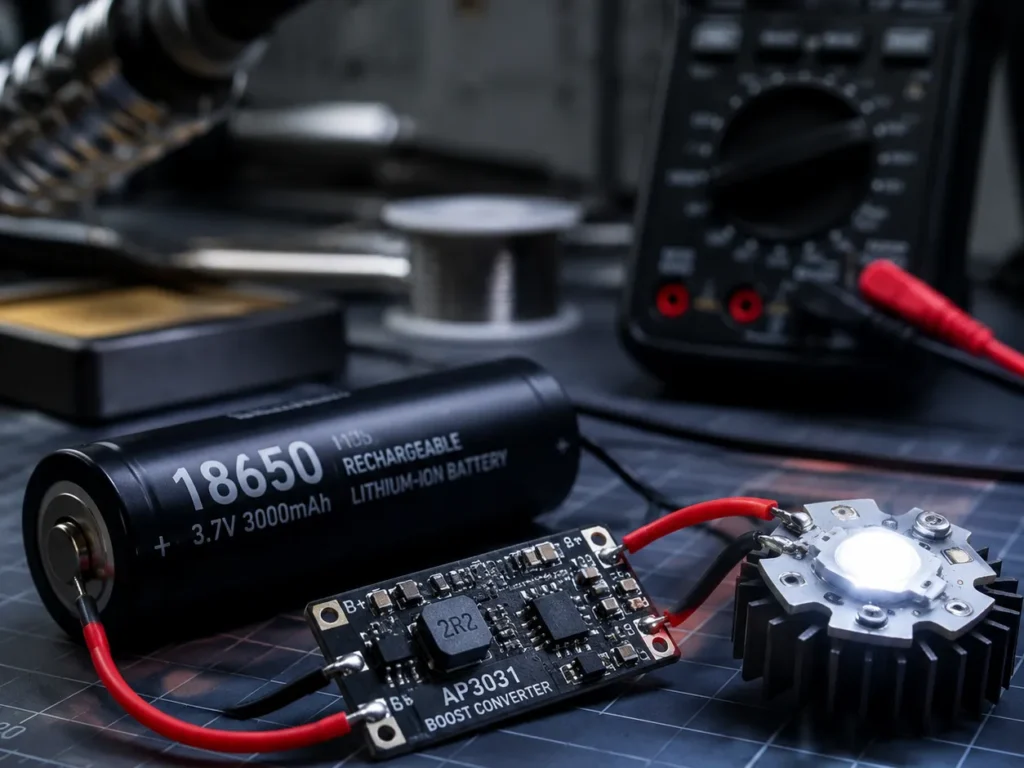
The AP3031 is a boost-type LED driver IC designed for applications where the LED load requires a higher voltage than the available input supply. It is a practical choice for portable lighting, battery-powered LED circuits, and rechargeable flashlight projects based on a single 18650 lithium-ion cell.
This article explains how the AP3031 works, how LED current is set, and what to consider when using it in a real circuit.
What the AP3031 Does
The AP3031 combines a switching boost converter with LED current regulation. Instead of applying battery voltage directly to an LED, the IC raises the voltage when necessary and controls the current flowing through the LED load.
This is especially useful when:
- The input supply is low, such as a single 3.7V lithium-ion battery
- The LED forward voltage is higher than the battery voltage
- Stable brightness is required while battery voltage changes during discharge
Main Features
- Boost converter architecture
- Input voltage range: approximately 2.7V to 16V
- Switching frequency: around 1.4MHz
- Adjustable LED current
- Compact external component count
- Thermal shutdown protection
- Overcurrent and overvoltage protection support
How the AP3031 Works
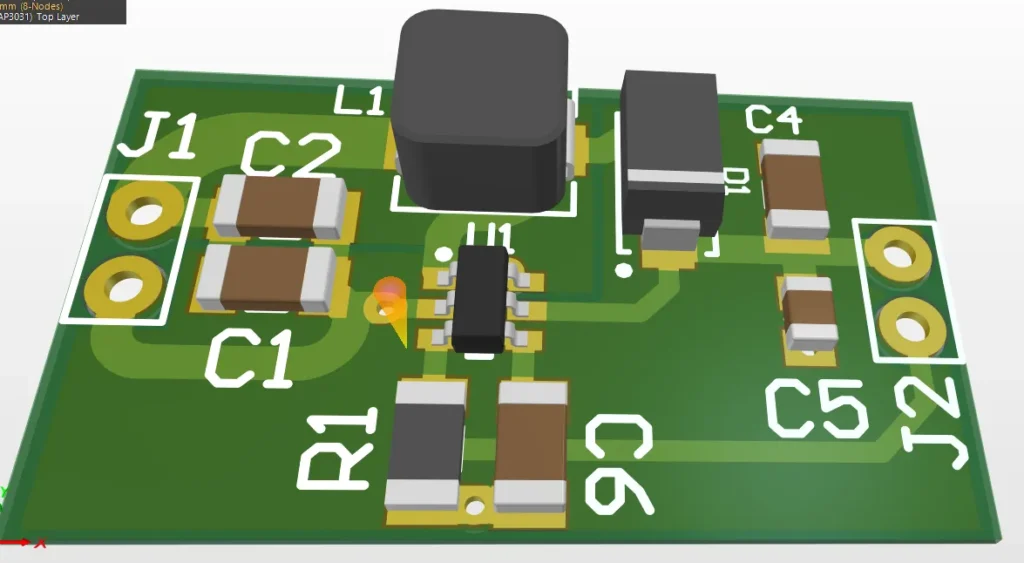
The AP3031 uses a switching regulator topology with an inductor, diode, capacitors, and a current-setting resistor. During operation, the IC stores energy in the inductor and transfers that energy to the output, creating a voltage higher than the input supply.
This boosted output is then used to drive one LED or multiple LEDs connected in series.
Voltage Boost Function
In a typical flashlight design, the input may come from a single 18650 battery with a voltage ranging from roughly 2.7V to 4.2V. If the LED load needs a higher voltage, the AP3031 raises the output to the required level.
Depending on the circuit design and load conditions, the output can be much higher than the battery voltage.
Current Regulation Function
LED performance depends strongly on current control. The AP3031 monitors the current-setting network and adjusts switching activity to keep LED current close to the target value.
This improves:
- brightness consistency
- LED lifetime
- overall circuit reliability
LED Current Setting Formula
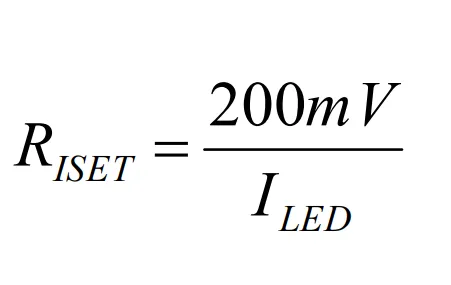
According to the device operating principle used in this design, the LED current is approximately determined by the RISET resistor:
ILED ≈ 200mV / RISET
This relationship is very useful when selecting the resistor for a desired LED current.
Example Calculation
If the target LED current is 55mA:
RISET = 200mV / 55mA ≈ 3.63Ω
So, a resistor close to 3.63 ohms would be used to set the current near that value.
Overvoltage Protection
The OV pin is used for output overvoltage protection. In many practical circuits, this pin is connected to the output side so the IC can monitor the output voltage.
If the output voltage rises to around 17.5V, the overvoltage protection function becomes active and prevents the output from rising further.
This is helpful in fault conditions such as an open LED load.
Main External Components
1) Inductor
The inductor is one of the most important parts of the boost converter stage. Typical values are often in the range of 4.7µH to 22µH, depending on the input voltage, output voltage, and load current.
Design note:
- If the inductor value is too small, current ripple may increase and saturation can become a problem
- If the inductor value is too large, transient response may slow down
2) Schottky Diode
A fast Schottky diode such as SS14 or 1N5819 is typically used. It should be selected with appropriate current and voltage ratings for the design.
3) Input and Output Capacitors
Capacitors help reduce ripple and improve stability. Proper capacitor selection is important for efficient switching operation.
4) RISET Resistor
This resistor defines the LED current target and should be selected carefully based on the intended LED operating current.
Typical Use Cases
- Rechargeable flashlights
- Portable inspection lights
- Battery-powered LED modules
- Series LED driving from low-voltage sources
- Custom DIY lighting products
Why the AP3031 Is Useful in 18650 Designs
A single lithium-ion cell is convenient and compact, but its voltage is often too low to directly power certain LED loads properly. The AP3031 solves this problem by boosting the voltage while maintaining current control.
This gives the designer several advantages:
- better use of battery energy
- more stable light output
- support for higher LED forward voltages
- a compact circuit for portable products
Important Practical Notes
- Always verify the LED current rating before selecting RISET
- Make sure the inductor current rating is suitable for the design
- Use correct PCB layout practices for switching circuits
- Provide thermal management for high-power LEDs
- Test the output voltage behavior under open-load and normal-load conditions
Conclusion
The AP3031 boost LED driver is a useful IC for powering LEDs from low-voltage sources such as a single 18650 battery. It offers voltage boosting, current regulation, and protection features in a compact design with relatively few external parts.
For designers working on rechargeable flashlights or portable LED circuits, it can be an efficient and practical solution when the LED requires a higher voltage than the battery can supply directly.
Related Guides
If you are starting from the beginning and want the full flashlight build overview, see: How to Build a Rechargeable Flashlight with a 18650 Battery.
If you want to skip prototyping and use a tested board instead, go here: 18650 LED Driver Module for Rechargeable Flashlights.
Frequently Asked Questions
What is the AP3031 used for?
The AP3031 is a boost LED driver IC used to power LEDs from a low-voltage source by boosting the voltage when needed and regulating LED current for stable operation.
How do I set the LED current on the AP3031?
LED current is set using the RISET resistor. A commonly used relationship is ILED ≈ 200mV / RISET. Choose RISET based on the desired LED current.
What does the OV pin do on the AP3031?
The OV pin is used for output overvoltage protection. If the output rises to about 17.5V in typical configurations, overvoltage protection activates to prevent further voltage increase.
What external parts are required for an AP3031 boost LED driver circuit?
A typical circuit uses an inductor, a Schottky diode, input and output capacitors, and an RISET resistor, plus the LED load. Component values depend on the design target.
What should I consider when choosing the inductor?
Choose an inductor value suitable for the design and make sure its current rating is high enough to prevent saturation during peak switching current.