
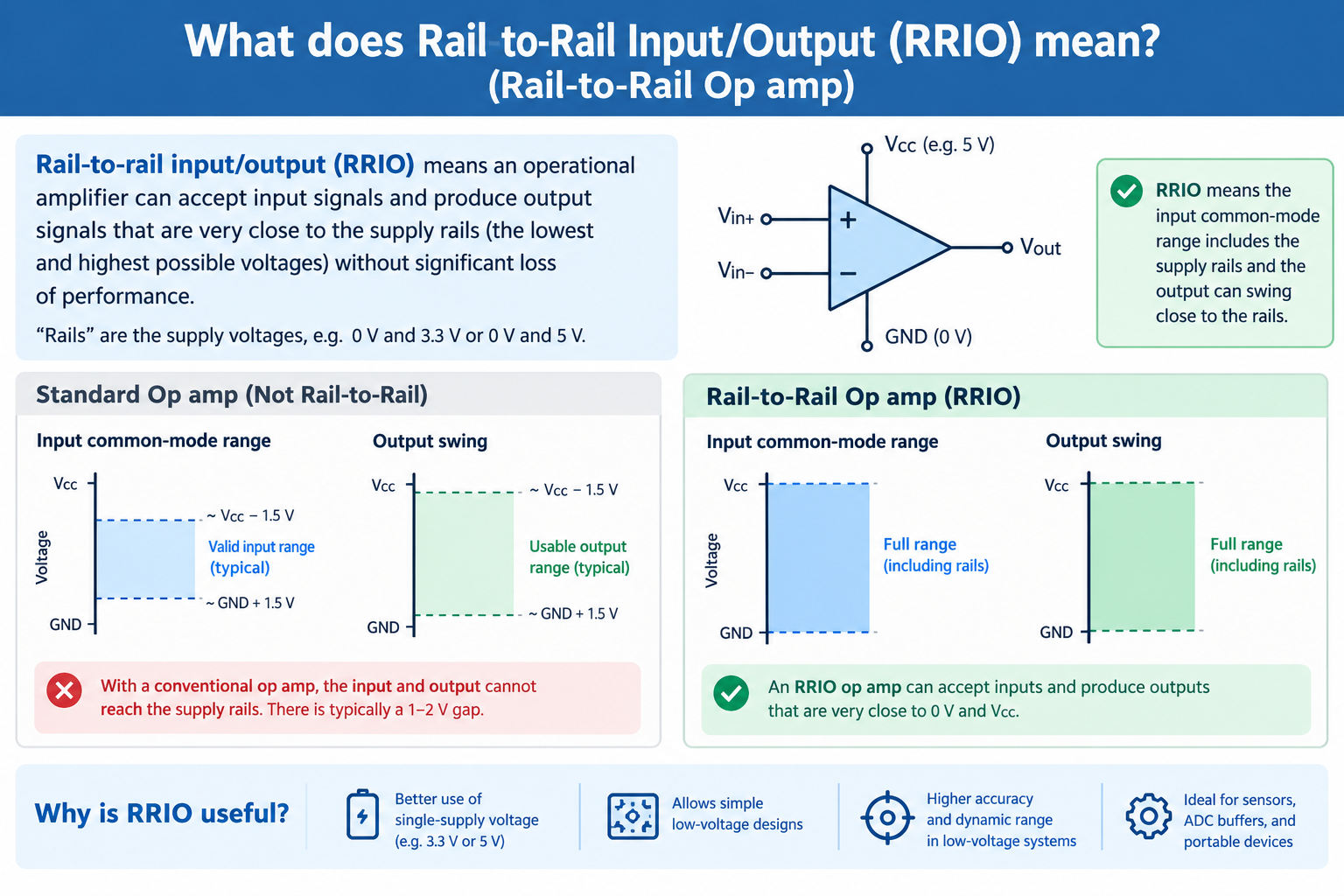
Rail-to-rail input/output (RRIO) is a feature in operational amplifiers (op-amps) where both the input and output voltage ranges can span nearly the full distance between the power supply rails. The “rails” refer to the positive (VCC or VDD) and negative/ground (VEE or GND) supply voltages powering the integrated circuit.
Title in Other Languages
- German: Was ist Rail-to-Rail Input/Output (RRIO) bei Operationsverstärkern?
- French: Qu’est-ce que le Rail-to-Rail Input/Output (RRIO) dans un amplificateur opérationnel ?
- Spanish: ¿Qué es Rail-to-Rail Input/Output (RRIO) en un amplificador operacional?
- Italian: Cos’è il Rail-to-Rail Input/Output (RRIO) in un amplificatore operazionale?
- Portuguese (Brazil): O que é Rail-to-Rail Input/Output (RRIO) em amplificadores operacionais?
Tip: Right-click anywhere on this page and choose “Translate to your language”.
Why RRIO Matters
Traditional op-amps require “headroom”. Their internal transistors prevent signals from getting too close to the power supplies. For example, if a traditional op-amp runs on a 5V single supply, it might only handle input and output signals between 1.5V and 3.5V. RRIO amplifiers eliminate this restriction. They allow the signals to move from 0V all the way to 5V. This capability is essential for low-voltage, battery-powered systems where maximizing the dynamic signal range is critical.The Component Breakdown
An RRIO designation combines two independent circuit architectures inside the chip:- Rail-to-Rail Input (RRI): The op-amp can accurately process input voltages that reach or slightly exceed both the positive and negative supply limits.
- Rail-to-Rail Output (RRO): The op-amp can drive its output voltage to within a few millivolts of either supply rail.
How it Works Internally
To achieve this performance, chip designers use specialized internal silicon structures:| Feature | Conventional Op-Amp | RRIO Op-Amp |
|---|---|---|
| Input Stage | Single differential transistor pair (either N-channel or P-channel). | Parallel complementary pairs (both N-channel and P-channel pairs working together). |
| Output Stage | Emitter-follower / Source-follower setup, which drops voltage across internal components. | Common-emitter or common-source configuration, minimizing internal voltage drops. |
Key Engineering Trade-offs
While highly versatile, RRIO op-amps introduce specific limitations that engineers must manage during system design:- Crossover Distortion: As the input voltage transitions from one supply rail to the other, the internal circuitry hands off the signal from the P-channel pair to the N-channel pair. This handover causes slight variations in input offset voltage and linearity.
- Load Dependency: The output stage can only truly hit the “rails” under light current loads. Drawing heavy current causes internal channel resistance to drop voltage, limiting the maximum output swing.
- Higher Component Cost: The parallel input architectures and precision trimming requirements increase silicon complexity compared to standard amplifiers.

